




Fast Rust CLI toolkit for sequencing QC metrics -- ports key QC metrics tools from Picard with cleaner output and better performance.


Visit us at Fulcrum Genomics to learn more about how we can power your Bioinformatics with riker and beyond.


Riker is the spiritual successor to picard for next-generation sequencing QC. It aims to provide modern, fast implementations of NGS QC metrics that tell you both "how does your sample look?" and often "why does it look bad?". It is not intended to be a drop-in replacement for Picard. Notably:
- Command line structure is different
- Output file formats are simplified and column names changed to resolve inconsistencies and confusion (and to use lower-case)
- Bugs that are difficult to fix in Picard due to implementation choices have been fixed in Riker, yielding slightly different outputs
Instead, Riker provides broadly similar tools to many of Picard's most widely used QC tools, with a goal of leading you to the same conclusions as before, in a lot less time. Riker will remain focused on QC tools, and not attempt to replicate other tools from Picard. Though other tools have been re-implemented for the better elsewhere too (e.g. fgumi's , fastq, sort, dedup, and zipper tools).
See the Available Tools section for a list of current tools.
The obvious question is: why not just fix up Picard? Riker exists for a number of reasons:
- Speed: Riker's tools run 12–38× faster than their Picard counterparts, measured across WGS, exome, and RNA-seq metrics (see Performance). Starting fresh also made it easy to compute all the metrics in a single pass over the input via one
multicommand — cutting both complexity and compute, since in PicardCollectWgsMetrics,CollectHsMetrics,CollectRnaSeqMetrics, andCollectMultipleMetricseach require a separate invocation and a separate read of the data. - Cleaner Output: Picard's tools output an inconvenient mostly-TSV format with a variable number of
#-commented header lines and sometimes multiple independent tables in the same file, making them harder than they should be to parse programmatically and annoying to review manually. Riker's outputs are simple TSVs with one table per output file that can easily be routed intocat file | column -tor python'scsv.DictReaderwith no fuss. In addition Riker standardizes on having thesamplebe the first column in every file - so you can easily concatenate files for many samples. - Lightweight Distribution: Picard carries a lot of baggage. It needs a JVM. It needs R and much of the tidyverse in order to produce plots. The bioconda distribution requires a python interpreter to run it's wrapper script. Running
pixi init && pixi add picardresults in a 1.2GB environment! In contrast Riker is distributed as a single executable of < 10MB with no external dependencies. - Maintenance: Maintenance of Picard has been minimal for some time, with what little activity there is coming mostly from the community. Picard is owned by, but no longer actively led by, the Broad Institute, making its path forward unclear. Picard also suffers from some now-unnecessary complexity and years of less-than-necessary maintenance. All of this makes a fresh start more appealing.
Numbers below are from a reproducible benchmark pipeline run on July 5th 2026 on a single AWS m8a.2xlarge instance (8 vCPU AMD EPYC 9R45, 32 GB RAM, gp3 EBS provisioned at 1000 MiB/s), against publicly-available 1000 Genomes WGS BAMs (transcoded from CRAM and downsampled to 4–30×), the GIAB Ashkenazi exome trio, and two ENCODE RNA-seq BAMs. The benchmark was performed using riker 0.4.0 vs. the latest version of each tool available from bioconda as of the benchmark date.
Picard is the tool every one of Riker's tools was written to match, so we'll keep this part short: tool for tool, Riker computes the same metrics 12–38× faster.
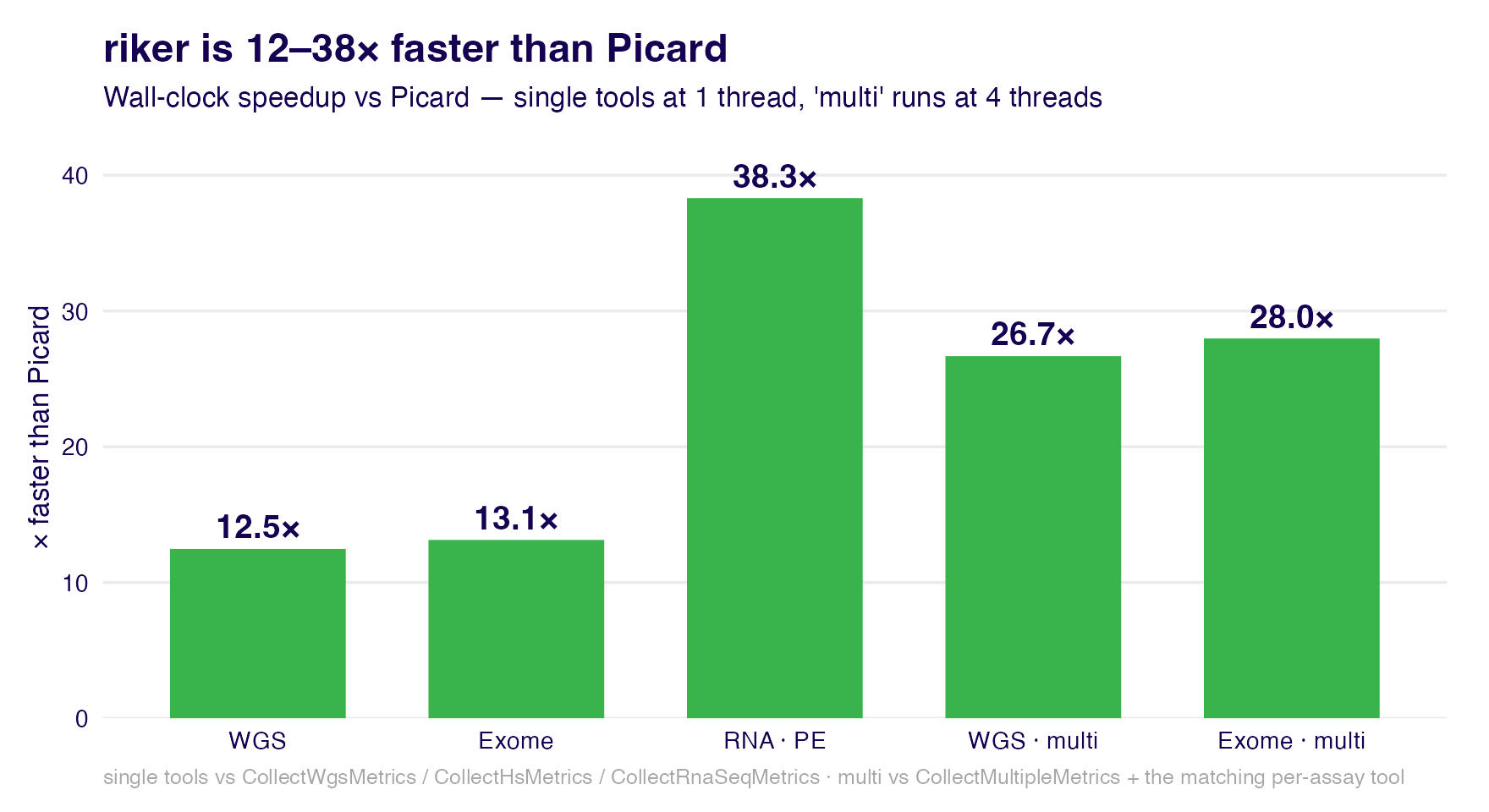
Whether single-threaded tool vs. tool, or multi-threaded via multi, Riker is massively faster than the aging Picard.
mosdepth is well known for being the fastest WGS coverage tool... until now. With both tools configured as closely to each other as possible, Riker is faster at every coverage and every thread count we measured — by 1.2–1.5×, with the biggest multipliers at low coverage.
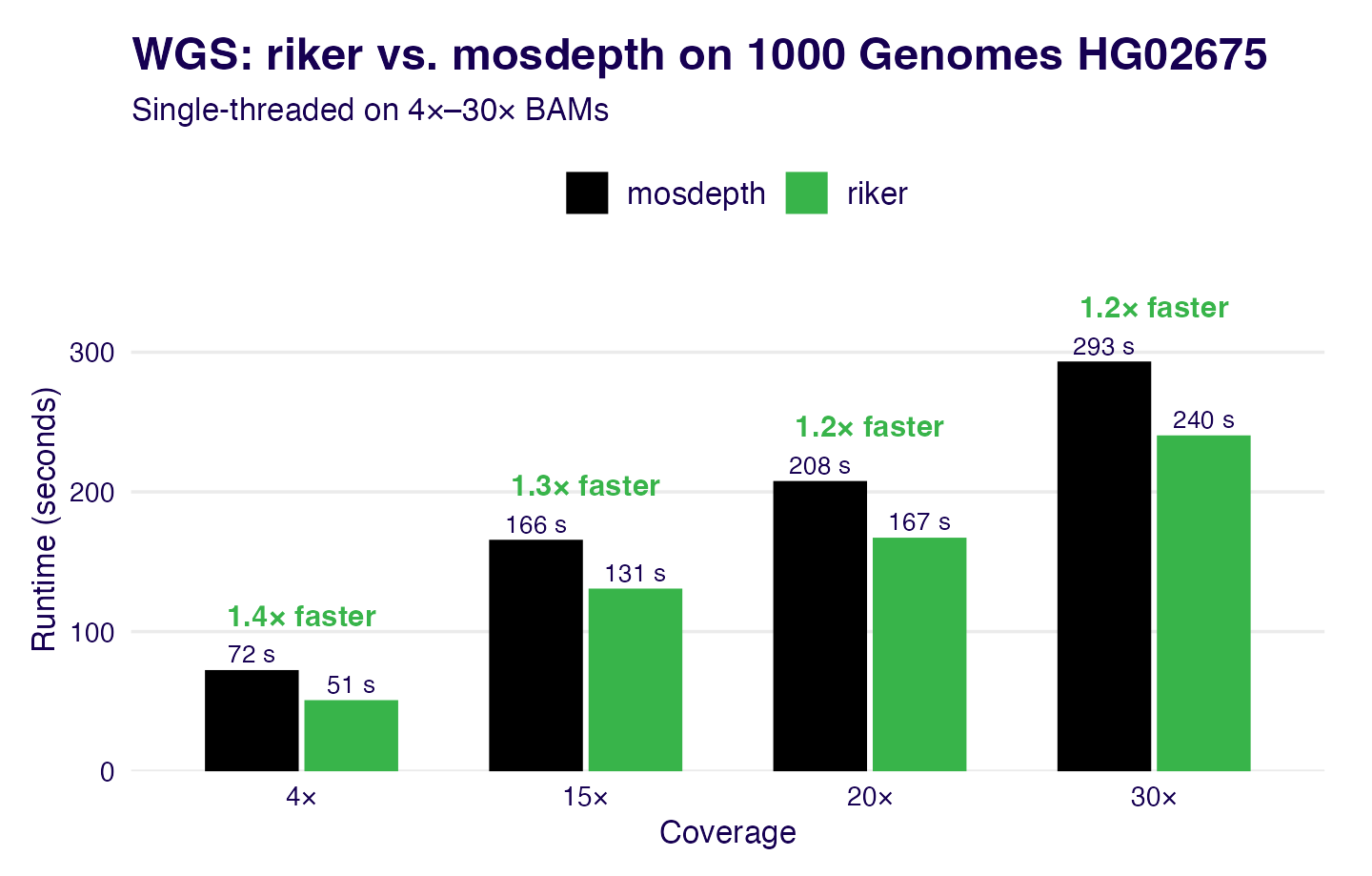
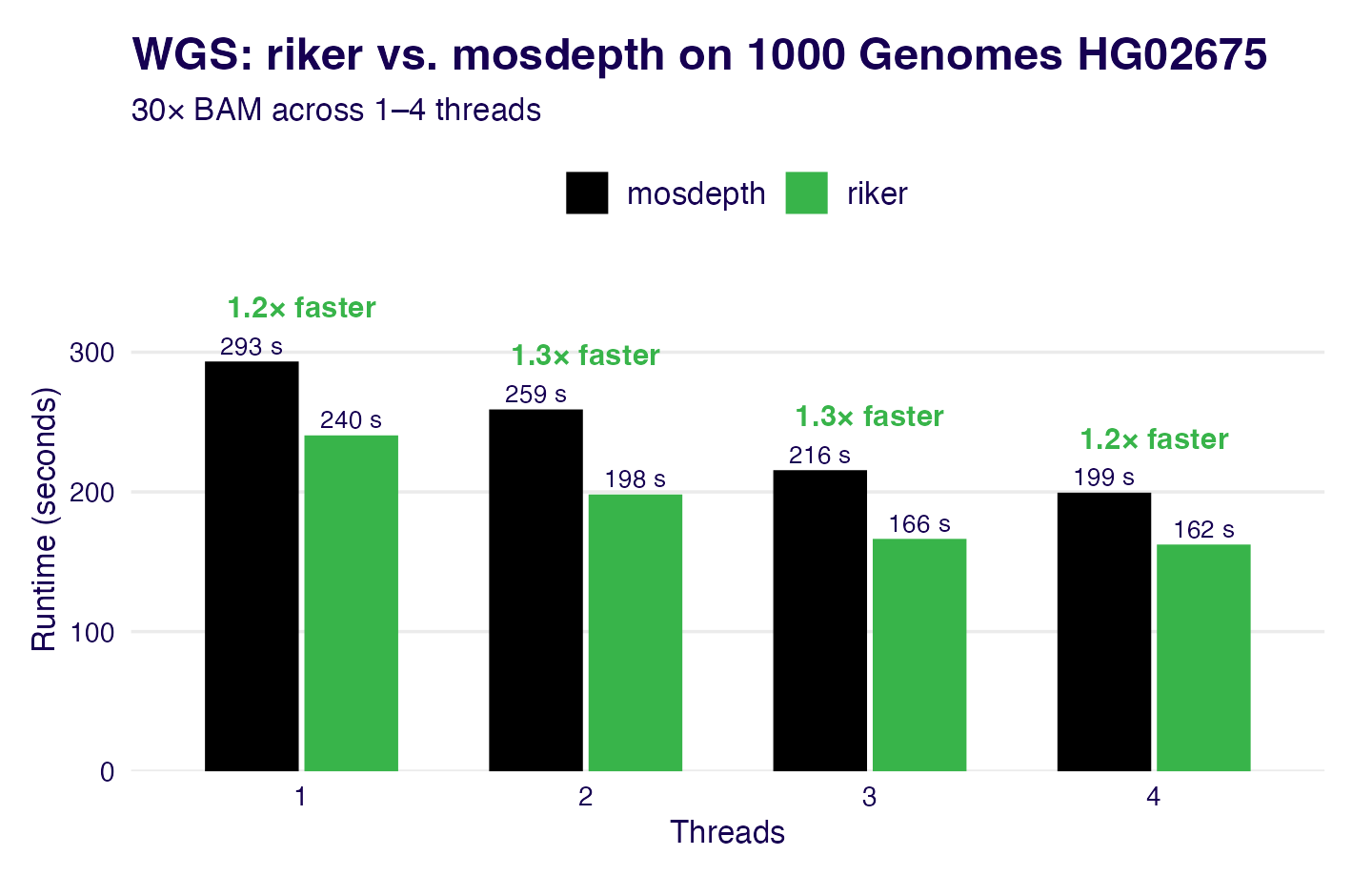
Riker wins while doing more per base: it applies base quality score filtering and quality-aware mate-overlap correction (matching Picard's WGS semantics), while mosdepth is not base quality aware. Base quality filtering is the one difference we couldn't harmonize away — mosdepth has no switch for it — so Riker is doing strictly more work and still finishes first.
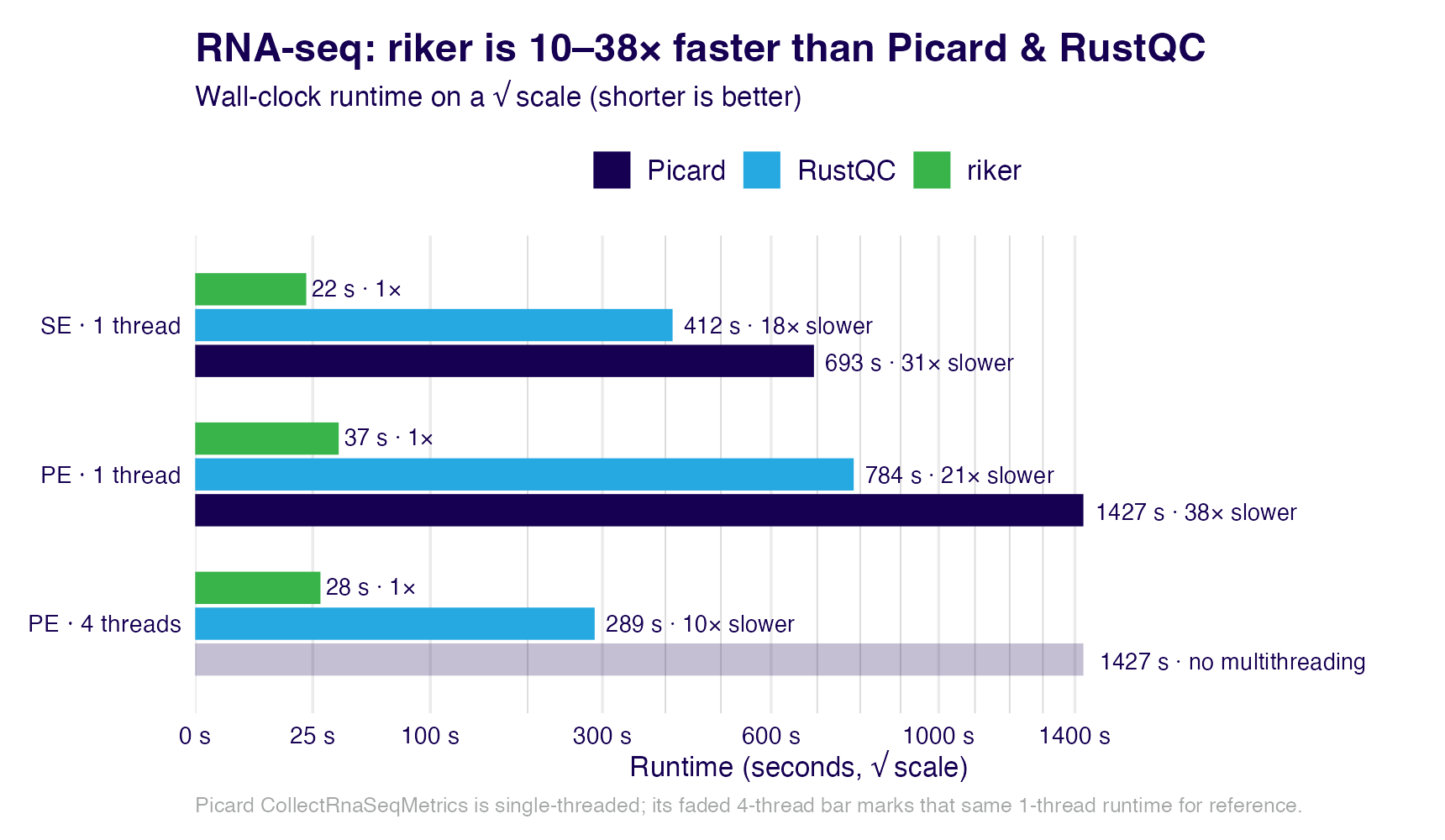
For RNA-seq the field also includes Picard CollectRnaSeqMetrics and RustQC (Seqera's Rust RNA-seq QC toolkit, which is advertised as ~60× faster than the tools it reimplements), scope-matched so all three compute a comparable set of metrics. Single-threaded, Riker runs 31–38× faster than Picard and 18–21× faster than RustQC. RustQC threads well, but even at four threads it is still ~10× behind Riker.
Using pixi, after adding the bioconda channel to your configuration:
pixi add riker
Or using your favorite conda client:
conda install -c bioconda riker
Riker can be installed from crates.io. If you're unfamiliar with cargo (the Rust build tool) but want to go this route, start by installing rustup.
cargo install riker-ngs
Similarly, to build from source you'll also need cargo. Once installed you can:
# clone the repo
git clone https://github.com/fulcrumgenomics/riker

# build the release version:
cd riker
cargo build --release| Command | Description | Equivalent Tool(s) |
|---|---|---|
alignment |
Collect alignment summary metrics | picard CollectAlignmentSummaryMetrics |
basic |
Collect base distribution, mean quality, and quality score distribution | picard CollectBaseDistributionByCycle, MeanQualityByCycle, QualityScoreDistribution |
error |
Collect base-level error metrics (mismatch, overlap, indel) | picard CollectSamErrorMetrics |
isize |
Collect insert size distribution metrics | picard CollectInsertSizeMetrics |
wgs |
Collect whole-genome coverage metrics | picard CollectWgsMetrics |
gcbias |
Collect GC bias metrics | picard CollectGcBiasMetrics |
hybcap |
Collect hybrid capture (bait/target) metrics | picard CollectHsMetrics |
rna |
Collect RNA-seq metrics (read origin, base composition, gene detection, splice junctions, strand, coverage bias, transcript integrity, transcript-space insert size) | picard CollectRnaSeqMetrics, fgbio EstimateRnaSeqInsertSize, RSeQC, RNA-SeQC, Qualimap |
multi |
Run multiple collectors in a single BAM pass | picard CollectMultipleMetrics |
docs |
Print metric field documentation | -- |
For detailed usage of each command, run:
riker <command> --helpCollect basic QC metrics (base distribution, mean quality, quality score distribution):
riker basic -i sample.bam -o out_prefixCollect alignment summary metrics with a reference:
riker alignment -i sample.bam -r ref.fa -o out_prefixCollect base-level error metrics with stratification:
riker error -i sample.bam -r ref.fa -o out_prefix
riker error -i sample.bam -r ref.fa -o out_prefix --vcf known.vcf.gz --stratify-by read_num,cycle bq
Collect insert size metrics:
riker isize -i sample.bam -o out_prefixCollect whole-genome coverage metrics:
riker wgs -i sample.bam -r ref.fa -o out_prefix
riker wgs -i sample.bam -r ref.fa -o out_prefix -L intervals.bed
Collect GC bias metrics:
riker gcbias -i sample.bam -r ref.fa -o out_prefix
riker gcbias -i sample.bam -r ref.fa -o out_prefix --exclude-intervals artifacts.bed
Collect hybrid capture metrics:
riker hybcap -i sample.bam -o out_prefix --baits baits.bed --targets targets.bed
riker hybcap -i sample.bam -o out_prefix --baits baits.bed --targets targets.bed -r ref.fa
The input BAM must be coordinate-sorted.
Collect RNA-seq metrics (the gene-model format — UCSC refFlat, GTF, or GFF3 — is auto-detected):
riker rna -i sample.bam -o out_prefix --gene-model gencode.gtf.gz
riker rna -i sample.bam -o out_prefix --gene-model refFlat.txt.gz --ribosomal-intervals rRNA.interval_list
riker rna -i sample.bam -o out_prefix --gene-model genes.gff3.gz --strand reverse
Run multiple collectors in a single pass:
riker multi \
  -i sample.bam \
  -r ref.fa \
  -o out_prefix \
  --tools alignment isize basic hybcap \
  --hybcap::baits baits.bed \
--hybcap::targets targets.bedRiker takes a single, whole-toolkit --threads budget. It's a global option, so
it works either before or after the subcommand:
riker --threads 4 wgs -i sample.bam -r ref.fa -o out_prefix
riker multi --threads 4 -i sample.bam -r ref.fa -o out_prefix --tools wgs gcbias basic alignment isize
--threads is the number of cores riker will try to saturate; it may spin a
few more threads internally (e.g. a dispatch thread) to keep them busy. Each
command spends the budget as it sees fit. The single-pass tools (wgs,
alignment, …) run their own work on one thread and hand the remainder to
input decoding; multi lays it out across input-decode threads, a dispatch
thread, and parallel collector workers, tuned to the input format. Left unset,
the single-pass tools run single-threaded and multi uses a small default pool.
The payoff is format-dependent: BAM inflate is cheap, so multi is
compute-bound and leans on collector workers; CRAM decode is expensive and
parallelizes well, so it leans on decode threads (and CRAM peak memory rises
with thread count, especially for the heavier archive/small codecs, while
BAM stays essentially flat). Gains are sub-linear — as a rough guide returns
flatten past ~6 threads for BAM and ~8 for CRAM — but the sweet spot is
platform- and input-dependent, and over-supplying threads can slow a run down,
so it's worth measuring on your own data.
Riker produces PDF plots using kuva, and plain TSV output designed for easy downstream consumption:
- Lowercase snake_case headers (e.g.,
total_reads,mean_insert_size) - Tab-separated with no metadata or comment lines
- Fractions use
frac_prefix instead ofpct_(e.g.,frac_alignednotpct_aligned) - No per read-group or library breakdown -- all reads in the file are combined
To see detailed documentation on the columns output in each file type run riker docs.
Riker aims to reproduce the metrics of Picard — and the other tools it ports — as closely as possible. Where behavior intentionally differs (corrections of known bugs, or deliberate design choices), every difference is documented per command in ERRATA.md:
alignment—mean_aligned_read_lengthis over aligned (not all PF) reads; improper-pair counting requires a mapped mate.hybcap— chimeric-pair overlap clipping is fixed; per-target GC is N-aware.gcbias— explicit read-accounting schema, a forward-strand window-binning fix, and optional--min-mapq/--exclude-intervals.error— reference-N positions skipped, mismatch denominator excludes insertions, raw-rate Q-scores, and 17 of Picard's 32 stratifiers ported.rna— a single-pass superset of PicardCollectRnaSeqMetrics+ fgbioEstimateRnaSeqInsertSize, plus RSeQC / RNA-SeQC / Qualimap metrics (read origin, gene detection, splice junctions, transcript integrity (TIN), biotype); several Picard coverage/bias off-by-ones are corrected; coordinate-sorted input is required. Transcript-space insert size uses theMC(mate CIGAR) tag when present and otherwise estimates FR pairs from a spec-compliantTLEN(addMCwithsamtools fixmate -mfor exact results). The biggest absolute difference from the reference tools is TIN, which riker reports ~14–16 points higher than RSeQC/RustQC (same shape, different scale — riker scores one well-covered transcript per gene); both track degradation equally well and riker is notably more depth-robust — see docs/rna-integrity.md.
Development of riker is supported by Fulcrum Genomics.
This software is under active development. While we make a best effort to test this software and to fix issues as they are reported, this software is provided as-is without any warranty (see the license for details). Please submit an issue, and better yet a pull request as well, if you discover a bug or identify a missing feature. Please contact Fulcrum Genomics if you are considering using this software or are interested in sponsoring its development.