The most up to date documentation is in this README.


Width-sensitive formatter for Julia code. Inspired by gofmt, refmt, and black.
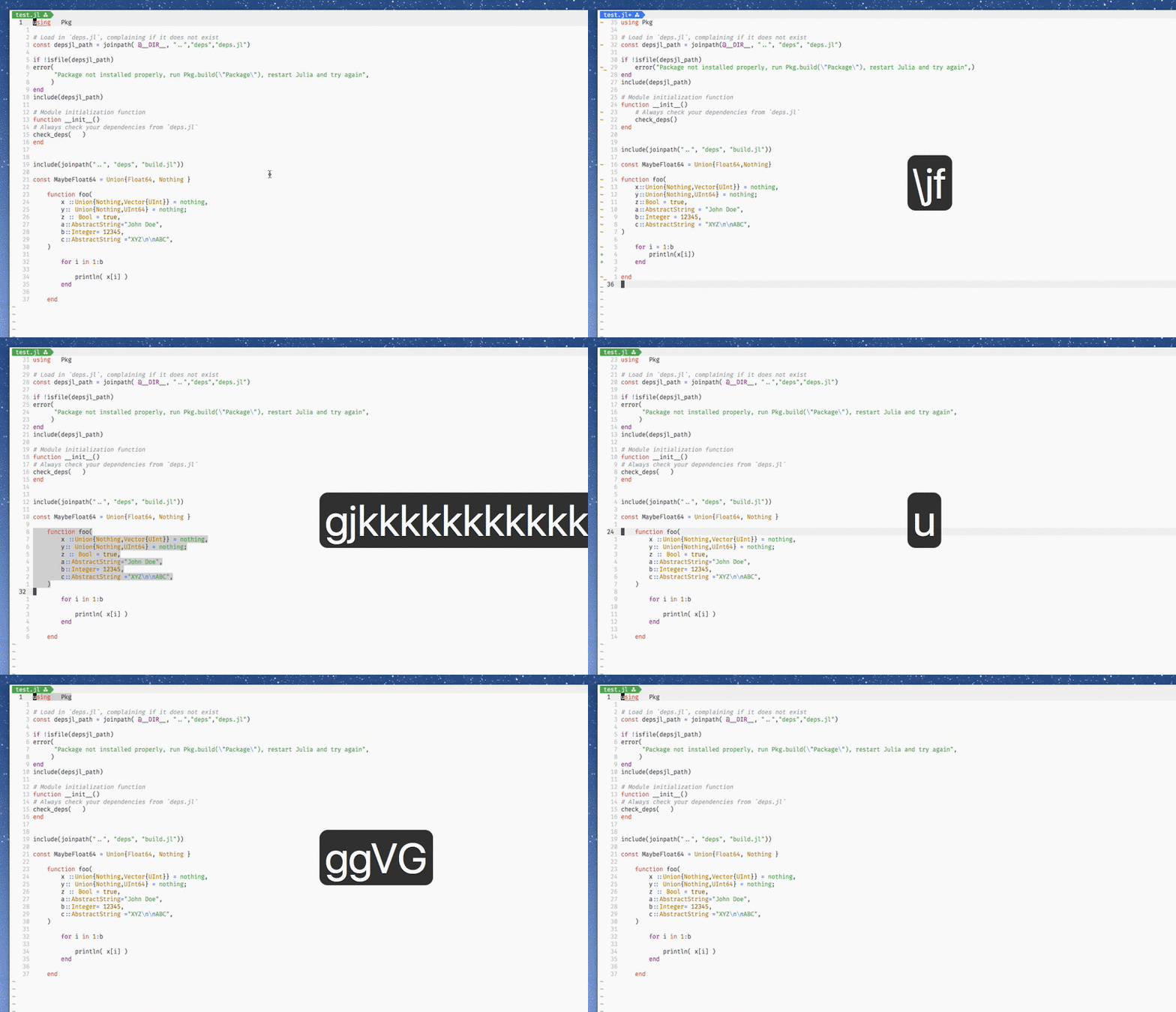
]add JuliaFormatterjulia> using JuliaFormatter
# Recursively formats all Julia files in the current directory
julia> format(".")
# Formats an individual file
julia> format_file("foo.jl")
# Formats a string (contents of a Julia file)
julia> format_text(str)Check out the docs for further description of the formatter and its options.
default:
4
The number of spaces used for an indentation.
default:
92
The maximum length of a line. Code exceeding this margin will be formatted across multiple lines.
default:
false
If true, = is always replaced with in if part of a for loop condition.
For example, for i = 1:10 will be transformed to for i in 1:10. Set
this to nothing to leave the choice to the user.
default:
false
If true, whitespace is added for type definitions. Make this true
if you prefer Union{A <: B, C} to Union{A<:B,C}.
default:
false
If true, whitespace is added for binary operations in indices. Make this
true if you prefer arr[a + b] to arr[a+b]. Additionally, if there's
a colon : involved, parenthesis will be added to the LHS and RHS.
Example: arr[(i1 + i2):(i3 + i4)] instead of arr[i1+i2:i3+i4].
default:
false
If true, superfluous newlines will be removed. For example:
module M


a = 1

function foo()


    return nothing

end


b = 2


end
is rewritten as
module M

a = 1

function foo()
    return nothing
end

b = 2

end
Modules are the only type of code block allowed to keep a single newline prior to the initial or after the final piece of code.
default:
false
If true, import expressions are rewritten to using expressions
in the following cases:
import A

import A, B, C
is rewritten to:
using A: A

using A: A
using B: B
using C: C
Exceptions:
If as is found in the import expression. using CANNOT be used in this context. The following example will NOT BE rewritten.
import Base.Threads as thIf import is used in the following context it is NOT rewritten. This may change in a future patch.
@everywhere import A, Bdefault:
false
If true, x |> f is rewritten to f(x).
default:
false
Transforms a short function definition
f(arg1, arg2) = bodyto a long function definition if the short function definition exceeds the maximum margin.
function f(arg2, arg2)
    body
enddefault:
false
Transforms a long function definition
function f(arg2, arg2)
    body
end
to a short function definition if the short function definition does not exceed the maximum margin.
f(arg1, arg2) = bodydefault:
false
If true, return will be prepended to the last expression where
applicable in function definitions, macro definitions, and do blocks.
Example:
function foo()
    expr1
    expr2
end
to
function foo()
    expr1
    return expr2
enddefault:
true
If true, = in keyword arguments will be surrounded by whitespace.
f(; a=4)to
f(; a = 4)An exception to this is if the LHS ends with "!" then even if whitespace_in_kwargs is
false, = will still be surrounded by whitespace. The logic behind this intervention being
on the following parse the ! will be treated as part of =, as in a "not equal" binary
operation. This would change the semantics of the code and is therefore disallowed.
default:
true
Annotates fields in a type definitions with ::Any if no type annotation is provided:
struct A
    arg1
end
to
struct A
    arg1::Any
enddefault:
false
Format code docstrings with the same options used for the code source.
Markdown is formatted with CommonMark alongside Julia code.
default:
false
See Custom Alignment documentation.
default:
false
If the conditional E ? A : B exceeds the maximum margin converts it into the equivalent if block:
if E
    A
else
    B
enddefault:
"auto"
One of "unix" (normalize all \r\n to \n), "windows" (normalize all \n to \r\n), "auto" (automatically
choose based on which line ending is more common in the file).
default:
true
One of true, false, or nothing.
Trailing commas are added after the final argument when nesting occurs and the closing punctuation appears on the next line.
For example when the following is nested (assuming DefaultStyle):
funccall(arg1, arg2, arg3)it turns into:
funccall(
    arg1,
    arg2,
    arg3, # trailing comma added after `arg3` (final argument) !!!
)- When set to
true, the trailing comma is always added during nesting. - When set to
false, the trailing comma is always removed during nesting. - When set to
nothing, the trailing comma appears as it does in the original source.
default:
true
Add a trailing zero, if needed.
default:
false
When true lines are joined as they appear in the original source file.
function foo(arg1,
                       arg2, arg3
                       )
       body
end
When false and the maximum margin is > than the length of "function foo(arg1, arg2, arg3)"
this is formatted to
function foo(arg1, arg2, arg3)
    body
end
When true, arg1 and arg2, arg3 will remain on separate lines even if they can fit on the
same line since it's within maximum margin. The indentation is dependent on the style.
function foo(arg1,
    arg2, arg3,
)
end
There are exceptions to this:
if a body1 elseif b body2 else body3 endwill be formatted to the following, even if this option is set to true:
if a
body1
elseif b
body2
else
body3
end!!! warning
The maximum margin still applies even when this option is set to `true`.
default:
false
When set to true, submodule(s) appearing in the same file will be indented.
module A
a = 1

module B
b = 2
module C
c = 3
end
end

d = 4

end
will be formatted to:
module A
a = 1

module B
    b = 2
    module C
        c = 3
    end
end

d = 4

end
When set to :module, all module(s) appearing in the same file will be indented.
module A
a = 1

module B
b = 2
end

d = 4

end
will be formatted to:
module A
    a = 1

    module B
        b = 2
    end

    d = 4

enddefault:
false
When set to true, keyword arguments in a function call will be separated with a semicolon.
f(a, b=1)

->

f(a; b=1)default:
true
Surrounds type parameters with curly brackets when set to true if the brackets are not
already present.
function func(...) where TPARAM
end

->

function func(...) where {TPARAM}
endCan be used when always_for_in is true to replace the default in with ∈ (\\in),
or = instead. The replacement options are ("in", "=", "∈").
for a = 1:10
end

# formatted with always_for_in = true, for_in_replacement = "∈"
for a ∈ 1:10
endThe SciMLStyle supports the additional options variable_call_indent and yas_style_nesting.
The option variable_call_indent is set to [] by default.
It allows calls without aligning to the opening parenthesis:
# Allowed with and without `Dict in variable_call_indent`
Dict{Int, Int}(1 => 2,
    3 => 4)

# Allowed when `Dict in variable_call_indent`, but
# will be changed to the first example when `Dict ∉ variable_call_indent`.
Dict{Int, Int}(
    1 => 2,
    3 => 4)
The option yas_style_nesting is set to false by default.
Setting it to true makes the SciMLStyle use the YASStyle nesting rules:
# With `yas_style_nesting = false`
function my_large_function(argument1, argument2,
    argument3, argument4,
    argument5, x, y, z)
    foo(x) + goo(y)
end

# With `yas_style_nesting = true`
function my_large_function(argument1, argument2,
                           argument3, argument4,
                           argument5, x, y, z)
    foo(x) + goo(y)
enddefault:
true
If true the file will be reformatted in place, overwriting the existing file;
if it is false, the formatted version of foo.jl will not be written anywhere.
default:
false
If true details related to formatting the file will be printed to stdout.
default:
false
If true, Markdown files are also formatted. Julia code blocks will be formatted in
addition to the Markdown being normalized.
An array of paths to files and directories (with possible Glob wildcards) which will not be formatted.
You can skip sections of code by using the #! format: off and #! format: on comments.
# this should be formatted
a = f(aaa, bbb, ccc)

# this should not be formatted
#! format: off
a = f(aaa,
    bbb,ccc)

c = 102000

d = @foo 10 20

e = "what the foocho"
#! format: on

# this should be formatted
a = f(aaa, bbb, ccc)

# ok
If you wish to not format an entire file just add #!: format: off to the top of the file.
Sometimes you may wish for a block of code to not be indented. You can achieve this with #!: format: noindent.
begin
@muladd begin
    #! format: noindent
    a = 10
    b = 20
    begin
       # another inent
        z = 33
    end

    a * b
end
        end
is formatted to
begin
    @muladd begin
    #! format: noindent
    a = 10
    b = 20
    begin
        # another inent
        z = 33
    end

    a * b
    end
end
Notice the contents of @muladd begin is not indented.
#!: format: noindent can also be nested.
For integration with other editors: