Quickstart · How it works · Students · CLI · Evaluation · Docs




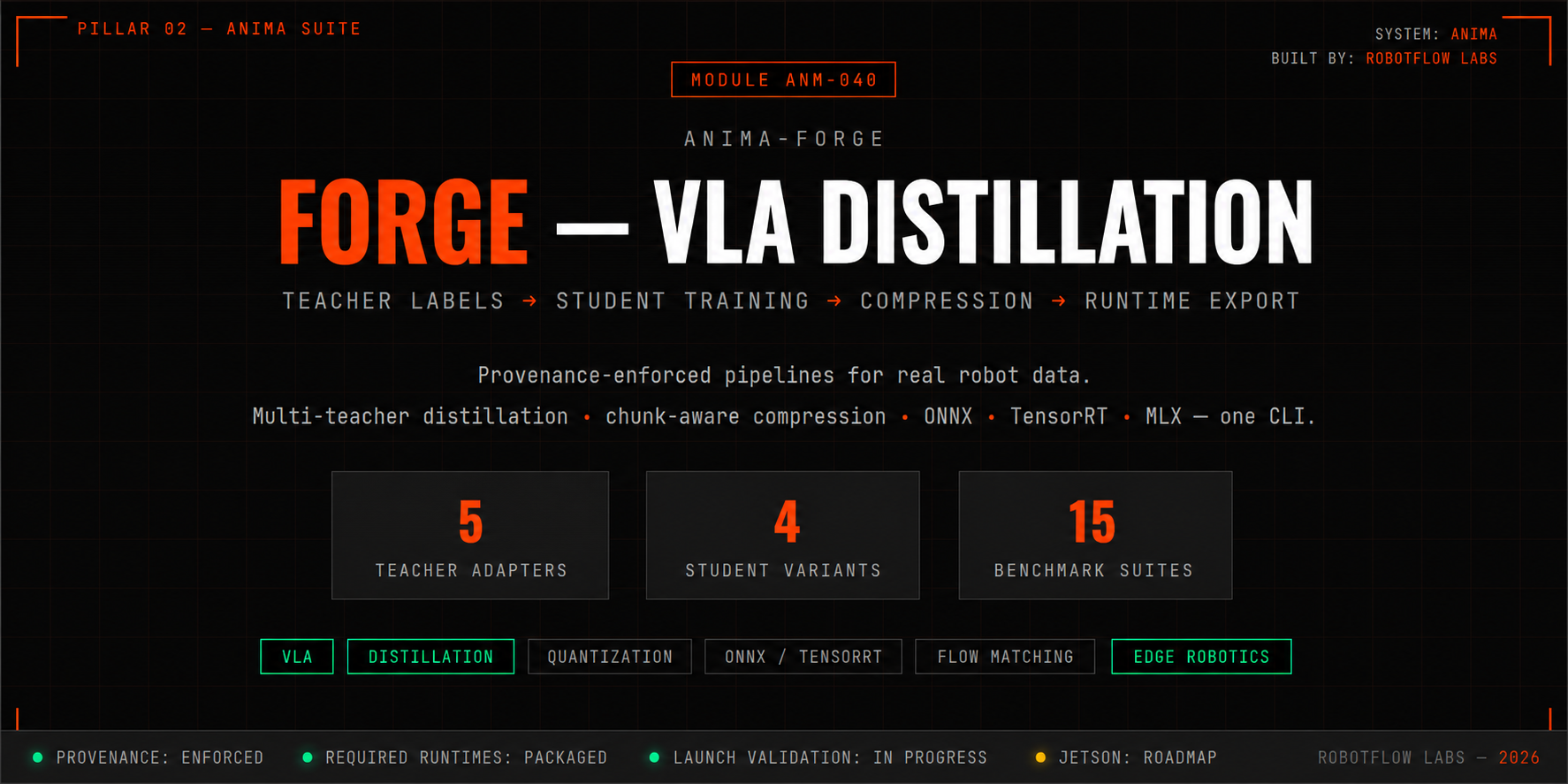
Large VLA teachers can control robots, but their memory and latency requirements often exceed edge deployment budgets.
FORGE provides a measured path through that problem. It generates provenance-tracked labels from registered teachers, trains defined student variants, compresses them, and validates runtime exports through one CLI. Performance claims remain unpublished until their real-data artifacts pass the launch gates below.
flowchart LR
    A["TEACHER FLEET<br/>OpenVLA · RDT-2 · SmolVLA · +"] -->|soft labels| B["DISTILL<br/>bridge warmup → full KD → action tune"]
    B --> C["COMPRESS<br/>chunk-aware prune + QVLA / TurboQuant"]
    C --> D["EXPORT<br/>ONNX · TensorRT · MLX"]
    D --> E["DEPLOY<br/>async runtime · FastAPI · edge"]
    style A fill:#1A1A1A,stroke:#FF3B00,color:#fff
    style B fill:#1A1A1A,stroke:#FF3B00,color:#fff
    style C fill:#1A1A1A,stroke:#FF3B00,color:#fff
    style D fill:#1A1A1A,stroke:#FF3B00,color:#fff
    style E fill:#050505,stroke:#00FF88,color:#00FF88
| Multi-teacher distillation | Ensemble any registered teachers; a learned router weights them per-sample, with confidence-aware routing, diversity and consistency losses |
| Modern action heads | Diffusion, flow matching, and chunked action prediction — plus consistency distillation that collapses inference to a single step |
| Compression that respects control | Chunk-aware layer pruning and action-centric quantization (QVLA, TurboQuant-MSE, PolarQuant) protect temporal coherence, not just accuracy |
| Runtime export paths | ONNX, TensorRT engines, MLX for Apple Silicon, FastAPI serving, and an async engine with action-chunk buffering |
| Training that manages itself | Curriculum learning, plateau-adaptive LR, hard-example mining, teacher dropout, Optuna auto-hyperparameter search |
| Agent-native by design | Automation-facing status and artifact commands provide strict --json; forge top returns a full machine-readable system snapshot |
Part of the ANIMA robotics stack by RobotFlow Labs.
The one-line Linux/macOS installer sets up an isolated FORGE tool, selects the CPU or
CUDA backend, and puts forge on PATH:
curl -fsSL https://raw.githubusercontent.com/RobotFlow-Labs/anima-forge/refs/heads/main/install.sh | shUse --cpu or --cuda to force the Torch backend. The CPU path resolves official
PyTorch CPU wheels while still installing FORGE's complete mandatory runtime set.
For a manual environment or an exact version pin, use the package path below.
# install (Python 3.12, NVIDIA GPU recommended)
pip install anima-forge

# is this machine ready? (GPU, models, disk)
forge doctor

# fetch the nano stack + real sample labels, then distill for 200 steps
forge quickstart --yes
If you need an unreleased checkout instead of the public PyPI package, install the wheel built
from this repository and pass a real local label directory. See the fully copy-pasteable
docs/QUICKSTART.md
path and its publication status note.
| Stage | What happens | Key tech |
|---|---|---|
| 1 · Teacher labels | Teachers run over demonstrations; soft labels stored as HDF5 | auto-discovering teacher registry, adapter pattern |
| 2 · Distillation | 3-phase KD: bridge warmup → full KD → action fine-tune | multi-teacher routing, curriculum, hard-example mining |
| 3 · Compression | Layer pruning + mixed-precision quantization | Shallow-Pi, QVLA, TurboQuant, chunk-aware importance |
| 4 · Export | Runtime conversion + validation + benchmark | torch dynamo ONNX, TensorRT INT8/FP16, MLX |
The current launch artifacts were trained for 5,000 steps per variant on four NVIDIA L4
GPUs using the corrected SigLIP2 real-label provenance pack, then exported and benchmarked
with real PushT video input. These numbers are release-smoke latency/export/provenance
measurements, not broad robot task-success claims. The exact machine-readable summary is
saved in hf_upload/benchmark_summary.json.
| Variant | Train steps | Final loss | QVLA INT4 ratio | QVLA INT4 artifact | ONNX CUDA p50 | ONNX FPS | PyTorch CUDA p50 | PyTorch FPS |
|---|---|---|---|---|---|---|---|---|
micro |
5,000 | 0.086293 | 6.927× | 304.1 MB | 64.931 ms | 15.365 | 126.958 ms | 7.770 |
nano |
5,000 | 0.085447 | 5.580× | 621.9 MB | 77.788 ms | 12.898 | 142.064 ms | 6.978 |
small |
5,000 | 0.085069 | 5.090× | 1397.2 MB | 105.381 ms | 9.444 | 160.774 ms | 6.189 |
medium |
5,000 | 0.085358 | 4.611× | 2604.2 MB | 163.489 ms | 6.096 | 172.796 ms | 5.764 |
Export status: ONNX Runtime CUDA and MLX exports completed for all four variants with
finite action outputs. TensorRT was attempted on micro, but engine build did not produce
a usable .engine on this host, so TensorRT numbers are intentionally not published here.
One architecture, four sizes — frozen SigLIP2-SO400M → Bridge Attention → LoRA'd LLM backbone → action head. AutoSense reads model configs and wires dimensions for you.
| Variant | Backbone | Backbone params | Intended role |
|---|---|---|---|
micro |
SmolLM2-135M | 0.135B | smallest development/edge student |
nano (default) |
Qwen3-0.6B | 0.6B | default edge student |
small |
Qwen3-1.7B | 1.7B | larger edge/server student |
medium |
Qwen3-4B | 4.0B | largest canonical student |
forge info                          # system + model readiness
forge teacher list                  # the teacher fleet
forge pipeline --device cuda        # end-to-end distillation
forge quantize run --method turboquant-mse --bits 4 --device cuda --json
forge benchmark list                # packaged real-world benchmark catalog
forge benchmark all --device cuda   # all suites; JSON artifacts land in benchmarks/
forge benchmark run --checkpoint outputs/checkpoints/best.pt --device cuda --json
forge hyperparam auto --trials 30 --seed 42  # reproducible Optuna search
forge eval run libero --checkpoint outputs/checkpoints/best.pt
forge serve --checkpoint outputs/checkpoints/best.pt --port 8000
forge web --port 3000               # Command Center dashboard
forge top --json                    # agent-oriented status snapshot
Full reference:
docs/CLI_REFERENCE.md
FORGE ships a VLA evaluation harness: it serves your student over WebSocket/msgpack and drives standard benchmarks in Docker — LIBERO, SimplerEnv, VLABench.
forge eval setup                    # pull benchmark images (one-time)
forge eval run-all --checkpoint outputs/checkpoints/best.pt --variant nano
forge eval compare --a v1.pt --b v2.ptsrc/forge/
├── teachers/ teacher adapters + auto-discovering registry
├── student.py SigLIP → Bridge Attention → LoRA backbone → action head
├── modules/ bridge attention · diffusion/flow/chunk heads · LoRA
├── distill.py 3-phase KD loop trainer.py production trainer
├── multi_teacher.py learned routing curriculum.py adaptive training
├── prune*.py chunk-aware pruning quantize/ QVLA · TurboQuant · PolarQuant
├── export/ ONNX · TensorRT · MLX runtime/ asynchronous action engine
├── eval/ VLA benchmark harness serve.py FastAPI endpoint
└── web/ Command Center dashboard + JSON API
Deep dive:
docs/ARCHITECTURE.md
| Doc | Contents |
|---|---|
| docs/README.md | Overview + quick start |
| docs/QUICKSTART.md | Real-label first distillation |
| docs/TROUBLESHOOTING.md | Common failures and exact fixes |
| docs/PIPELINE.md | 4-stage pipeline walkthrough |
| docs/CLI_REFERENCE.md | Every command |
| docs/CONFIGURATION.md | YAML + FORGE_* env vars |
| docs/EVALUATION.md | VLA benchmark guide |
| docs/DEPLOYMENT.md | Edge deployment |
| docs/HYPERPARAMETER_GUIDE.md | Auto-HP (Optuna) + tuning |
uv run ruff check src/ scripts/ tests/
uv run ruff format --check src/ scripts/ tests/
uv run mypy src/forge/ scripts/
uv run pytest tests/ -m "not gpu"
PRs target develop; main is release-only. Public usage and architecture documentation
live in
docs/.
Apache-2.0 © RobotFlow Labs / AIFLOW LABS