A diffusion model that turns raw audio into playable osu!standard beatmaps. Point it at a
song, pick a star rating, and it writes a .osu you can drop straight into osu! and play.
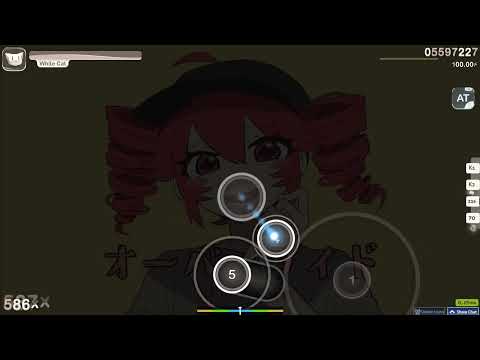
(click to watch generated maps played in-game — https://youtu.be/iMc9QJ8uyQM)
A beatmap is represented as a frame-aligned multi-channel signal at the audio's spectrogram
frame rate, and a 1D conditional diffusion U-Net (DDIM sampling, QK-norm attention) denoises
that signal conditioned on the mel spectrogram + a difficulty vector. The signal is decoded back
into hit objects — circles, curved sliders, spinners, hitsounds, kiai, slider-velocity — and
written to a valid .osu. (The full math is in
docs/knowledge/diffusion-math.md +
docs/knowledge/signal-encoding.md.)
audio.mp3 ──► log-mel (64×T) ──┐
                               ├─►  1D U-Net (DDIM denoise)  ──►  signal (21×T)  ──► decode ──► .osu
   noise (21×T) ───────────────┘     ▲ conditioned on mel + difficulty [SR,AR,OD,HP,CS,density]
The current model (v8, base-160) generates rhythm, jumps, streams, curved + reverse sliders,
red-corner sliders, slider-velocity sections, kiai and hitsounds. See
docs/status/results.md for the quality history, and
docs/INDEX.md for the full documentation map.
With uv (recommended — the CUDA torch index is wired in):
uv sync # creates .venv and installs everything (incl. CUDA torch)Or with pip:
pip install torch --index-url https://download.pytorch.org/whl/cu128
pip install -r requirements.txt
You also need an osu! install with a Songs library (the model is trained on, and generates into, your local Songs folder).
One command generates the map, prints its stats, and drops it into your Songs folder as a playable difficulty:
uv run python main.py infer \
    --audio "C:/osu!/Songs/123 Artist - Song/audio.mp3" \
    --reference "C:/osu!/Songs/123 Artist - Song/Artist - Song (Mapper) [Insane].osu" \
    --sr 5 6 7 --best-of-n 8
--best-of-n 8is the recommended flow: sample 8 candidates per SR, score each with the reward function, keep the best — a clear quality lift. (Needsartifacts/reference_stats.json, built bypython -m src.corpus_stats.)--referenceis any existing.osufor that song — it gives exact timing (BPM/offset) and lets the map be packaged with the right audio + background. Recommended; without it the map uses estimated timing and is just written to disk.--srtakes one or more star ratings; all land as difficulties in one beatmapset folder (F5 in osu!).- Handy flags:
--aim-intensity 0..1(per-song density/spacing dial — low = jumpier, high = streamier),--match-sr(iterate to hit the exact rating),--density(push streams),--compile(much faster on repeat runs — a persistent on-disk compile cache),--amp,--no-package.--helplists them all.
A pre-trained checkpoint is auto-discovered from runs/; pass --ckpt path/to/best.pt to choose one.
# 1. preprocess your ranked maps into a deduped, manifest-indexed dataset
uv run python main.py preprocess --songs "C:/osu!/Songs" --out data/processed/ranked --gold --workers 10

# 2. train (logs + checkpoints under runs/<id>/; --resume runs/<id>/ckpt/last.pt to continue)
uv run python main.py train --data data/processed/ranked --tag mymodel \
    --base 160 --crop 4096 --attn-levels 3 --batch 16 --epochs 80 --val-frac 0.10 \
    --objective v --zero-snr --compile --spatial-loss-weight 3 --rope --loss huber --huber-beta 0.5

# 3. generate with your checkpoint
uv run python main.py infer --audio song.mp3 --reference ref.osu --sr 5 --ckpt runs/<id>/ckpt/best.pt
Training uses bf16 + EMA + cosine LR, flip augmentation, and per-run logging. The val split holds out
whole songs (no audio leakage); add --val-reward-every N to log a real map-quality val_reward
(needs --ref-stats). best.pt keeps the lowest validation loss (EMA weights are used at inference).
main.py                  CLI entrypoint: preprocess | train | infer | generate
src/
  config.py              signal channel layout (21 ch) + frame<->time helpers
  conditioning.py        difficulty context vector [SR,AR,OD,HP,CS,density]
  difficulty.py          exact star rating (rosu-pp)
  metrics.py             pattern/quality metrics (spacing, stream/jump, curves, ...)
  postprocess.py         beat/slider snap, slider clamp, trim, breaks, jump respace
  package_map.py         build a playable osu! Songs folder (beatmapset) from generated maps
  run_inference.py       the friendly `infer` pipeline (generate -> stats -> package)
  parsing/beatmap.py     .osu parser + writer
  data/                  audio mel, signal encode/decode, timing, osu!.db, preprocess, dataset
  model/                 unet.py (1D conditional U-Net) + diffusion.py (DDPM/DDIM/CFG)
  train.py / generate.py training loop / low-level inference
  eval/                  analysis probes (real-vs-generated, spacing channel)
tests/                   142 hermetic tests (no dataset/GPU needed)
Everything heavy is git-ignored (/data/, /runs/, /artifacts/); only code + small configs
are tracked. A run is reproducible from runs/<id>/config.json (pins git commit + args).
- Sampler matters. Naive strided DDPM under-denoises into noise-like maps; use the DDIM sampler (correct over a step subsequence).
- Frame grid, not milliseconds. Everything is aligned on the audio frame grid to avoid drift.
- Slider duration comes from length. osu! derives a slider's duration from
length / velocity, so the writer clamps each slider's length to fit the gap before the next object, and slider ends are beat-snapped (else ~half land off-grid). - bf16 + attention can diverge. Fixed with QK-normalised attention + zero-init projection; base-160 needed v-prediction + zero-terminal-SNR to train stably (earlier ε-prediction runs diverged around epoch 12–21).
- Long songs (8-min marathons) materialise a big attention matrix — pass
--amp(bf16) so they fit in VRAM.
uv run pytest          # 142 hermetic tests (synthetic fixtures, no GPU/library needed)
uv run ruff check . # lint (rules in pyproject.toml, 100-col)- jaswon/osu-dreamer — the signal + diffusion approach
- OliBomby/osu-diffusion · Mapperatorinator — DiT-style coordinate diffusion
- gyataro/osuT5 · kotritrona/osumapper
- osu! file format wiki